halcheck::lib::subrange< I > Class Template Reference
Describes a range formed from a pair of iterators. More...
#include <subrange.hpp>
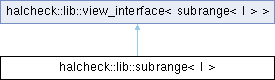
Inheritance diagram for halcheck::lib::subrange< I >:
Public Member Functions | |
| constexpr | subrange ()=default |
| Constructs an empty subrange. | |
| constexpr | subrange (I first, I last) |
| Constructs a subrange from a pair of iterators. | |
| constexpr I | begin () const |
| Gets an iterator pointing at the first element in the subrange. | |
| constexpr I | end () const |
| Gets an iterator pointing past the last element in the subrange. | |
| constexpr bool | empty () const |
| constexpr bool | empty () const |
| bool | empty () |
| bool | empty () |
| constexpr | operator bool () const |
| operator bool () | |
| constexpr auto | size () const -> decltype(lib::to_unsigned(lib::end(self< T >()) - lib::begin(self< T >()))) |
| auto | size () -> decltype(lib::to_unsigned(lib::end(self< T >()) - lib::begin(self< T >()))) |
| constexpr auto | front () const -> decltype(*lib::begin(self< T >())) |
| auto | front () -> decltype(*lib::begin(self< T >())) |
| constexpr auto | back () const -> decltype(*std::prev(lib::end(self< T >()))) |
| auto | back () -> decltype(*std::prev(lib::end(self< T >()))) |
| constexpr auto | operator[] (lib::range_difference_t< T > n) const -> decltype(lib::begin(self< T >())[n]) |
| auto | operator[] (lib::range_difference_t< T > n) -> decltype(lib::begin(self< T >())[n]) |
Detailed Description
template<typename I>
class halcheck::lib::subrange< I >
class halcheck::lib::subrange< I >
Describes a range formed from a pair of iterators.
- Template Parameters
-
I The type of iterator contained in the subrange.
The documentation for this class was generated from the following file:
- include/halcheck/lib/iterator/subrange.hpp
Generated by
 1.12.0